Absolute Cnc Machine Co., Ltd. Mobile/WhatsApp:+86 13115000086 E-mail:info@cnabsolute.com


Absolute Cnc Machine Co., Ltd. Mobile/WhatsApp:+86 13115000086 E-mail:info@cnabsolute.com

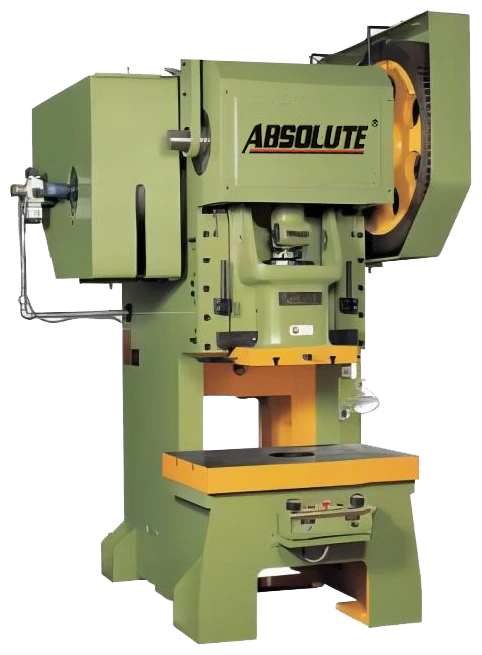
Punch press terminology can make equipment comparisons confusing. In crank-driven stamping equipment, the term pneumatic punch press often describes an air-operated clutch and brake rather than an air cylinder that supplies the stamping force. Before comparing quotations, ask what the supplier means by the term. Then review the drive, control arrangement, force and die space as a complete system for the operation you need to perform.
Start with the part drawing, material grade, thickness and required operation. Punching, blanking and forming can place different demands on the press and die. Explain whether the part will be made in a single operation, through several stations or with another tooling arrangement. If a die already exists, provide its drawings and working requirements instead of selecting the machine from tonnage alone.
Include cut perimeter or other force information if it has been established by the tooling designer. For forming, describe the force required through the working portion of the stroke. Ask the supplier to review the process with the proposed tooling. A preliminary force calculation is useful, but it does not establish die compatibility, press energy capacity or the suitability of the operating method.
For a mechanically driven press with an air-operated clutch and brake, a motor and mechanical transmission provide the stamping action. Compressed air operates or controls the clutch and brake system. The available air pressure is therefore a separate requirement from the press's rated force. It should not be used as a substitute for the machine's mechanical force and energy specifications.
Ask about the exact clutch and brake arrangement, operating modes and specified air supply. For a mechanical clutch configuration, identify whether it is a full-revolution design or another arrangement. Different designs have different cycle and stopping behavior. Have those details reviewed together with the feeding method and safeguarding, rather than assuming that a general product name establishes the necessary control functions.
A crank-driven press is commonly rated at a stated position near bottom dead center. The rated tonnage should not be treated as available at every point in the stroke. Ask where the rating applies and how the proposed machine's force limits relate to the die's working requirements. An operation occurring at a different position requires a specific review.
Available energy also matters. A press may have an adequate nominal force rating while the intended operation demands an unsuitable amount of energy or an unsuitable cycle. Provide the production target and intended operating pattern. Ask the supplier to explain the assumptions used when checking the application, including any limits on material, tooling or operating speed.
Give the supplier die length, width, height and guide arrangement. Confirm shut height, its adjustment range, stroke, slide dimensions, bolster or table dimensions and the required opening. Include the feed direction and the space needed for part ejection or scrap removal. Nominal force does not answer whether the tooling physically fits the press.
Review how the die will be installed, secured and changed. If several dies will be used, identify the largest, tallest and most demanding examples. The supplier should assess their requirements individually. Ask which dimensions refer to the press itself and which depend on a supplied bolster or another option, so the available working space is clear in the quotation.
Explain whether the press will use manual loading, strip feeding or another method. Include the size and weight of the material and the intended batch quantities. Ask how the feed sequence will be coordinated with the machine's operating modes. A stated strokes-per-minute figure does not establish the finished output of a process that also requires loading, positioning and unloading.
Guarding and control arrangements need to suit the actual press design and operating method. Ask for the exact equipment and documentation supplied, and have destination installation requirements reviewed by a competent person. Do not assume that a pneumatic clutch label means every protective device is compatible or that a generic photograph shows the complete quoted configuration.
A useful inquiry brings together the part drawing, material, tooling details, production target, feeding method and required control arrangement. Add destination country, electrical supply, workshop space and, where applicable, air pressure, flow and air quality. Ask the supplier to distinguish the press, tooling, feeder, safeguards, installation services and other options in the commercial scope.
For an initial checklist, use the punch press selection guide from Absolute CNC. Send both the part and die information when requesting a configuration. This lets a buyer compare a proposed stamping process, rather than comparing two tonnage figures that may describe different working conditions.
Have a part drawing to review? Send your machine requirements for a configuration and quotation.

Contact:Alice Li
Tel:+86 13115000086
E-mail:info@cnabsolute.com
Address:Mingjue Industry Zone,Lishui Town,Nanjing City,Jiangsu Province,CHINA.
Copyright © 1990-2026 Absolute Cnc Machine Co., Ltd. ABSOLUTE