Absolute Cnc Machine Co., Ltd. Mobile/WhatsApp:+86 13115000086 E-mail:info@cnabsolute.com


Absolute Cnc Machine Co., Ltd. Mobile/WhatsApp:+86 13115000086 E-mail:info@cnabsolute.com

Choose a press brake V-die by reviewing the part, tooling and load together. Use this checklist to prepare a clearer tooling or machine inquiry.
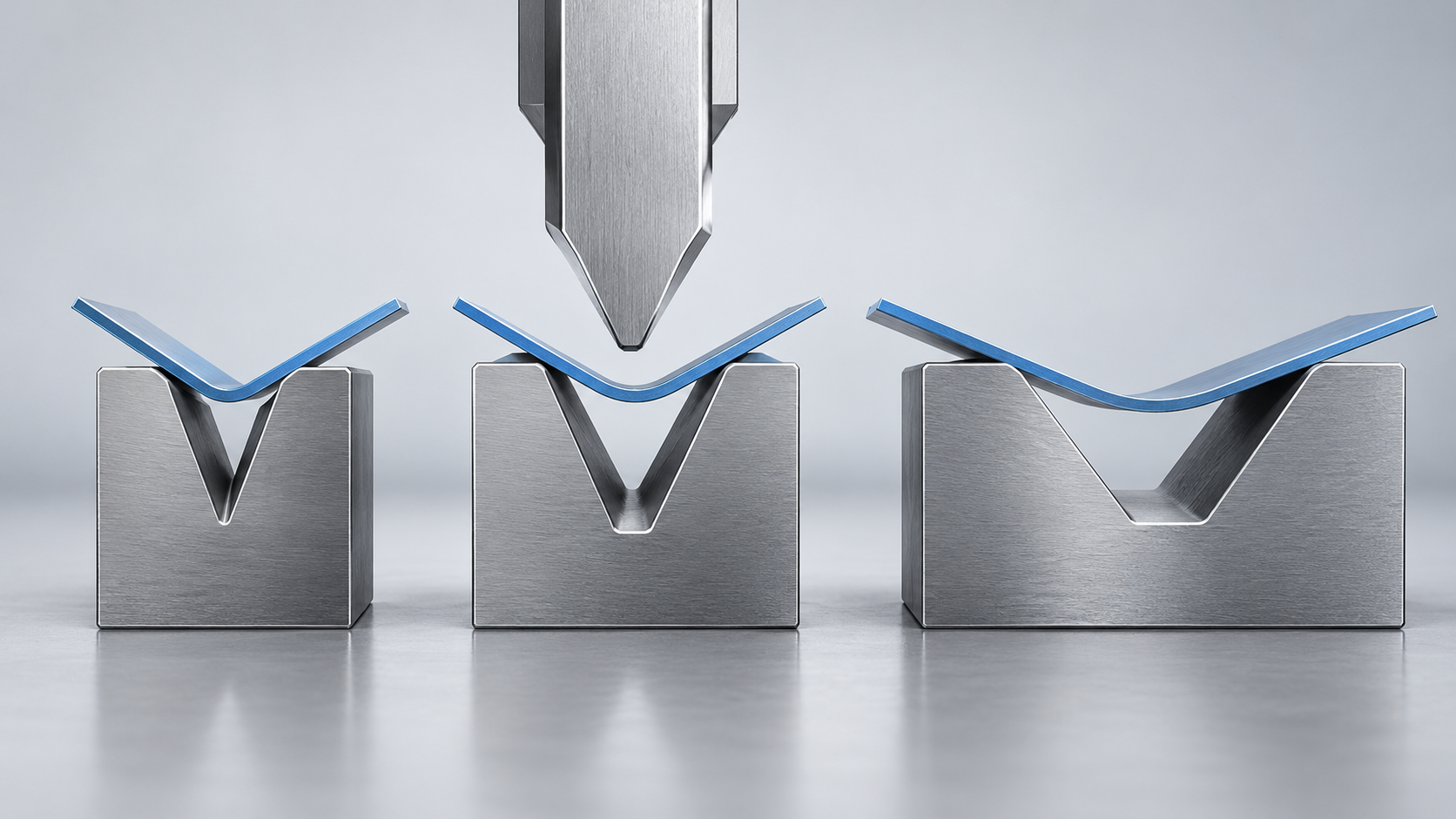
Conceptual illustration of different V-die openings; not a production setup drawing.
Choosing a press brake V-die opening starts with the part you need to make. Record the material grade, thickness range, bend angle, required inside radius and shortest flange. A die that suits the thickness may still be unsuitable for a short return or a box with limited clearance.
This guide covers air bending. For bottom bending, hemming or special forming operations, ask for a process-specific tooling review rather than reusing an air-bending setup.
The opening is a tooling choice with consequences for the finished part. In air bending, the formed inside radius depends on the opening as well as the material. Do not assume that it will simply copy the punch-tip radius. The opening also affects the required force and the flange that the tool can support.
Treat these as linked decisions: radius, force, flange and flat pattern. Changing one setup detail after blanks have been cut can affect the finished dimensions. WILA explains these relationships in its V-opening guidance linked below.
Use the tooling supplier's chart for the material, sheet thickness, opening and bending method under review. Check the chart units before comparing the result with a machine quotation: force per unit length and total bending force are different quantities.
WILA's published air-bending chart illustrates why the opening cannot be considered in isolation: it presents force, inside radius and minimum flange alongside the opening and thickness. Its material and process notes also distinguish air bending from bottoming. A chart is an input to the review, not permission to run an unverified setup.
Before ordering tooling, identify the shortest flange on each drawing. WILA notes that minimum flange capability depends on the die opening, shoulder radius and bend angle. Use the dimensions for the exact tool profile rather than assuming that any flange wider than half the opening will work.
For a part with holes, slots or a return close to the bend, send a drawing showing the feature positions. Ask the supplier to review support, clearance and the bend sequence together.
A useful quotation should answer two questions: can the proposed setup form the part, and can every relevant component carry the required load? Review the machine, punch, die, holders and the proposed loading arrangement. A machine's headline capacity alone does not answer both questions.
Ask for the tooling reference and planned setup in the quotation. If your drawing changes, send the revised file and revision number before confirming the order.
Suppose your drawing specifies a 2 mm sheet, a 90-degree bend and a short flange. You are comparing two proposed die openings. Do not select the wider one solely because the quoted force is lower.
Ask for a side-by-side review of the material grade, expected inside radius, minimum supported flange, required force and flat-pattern assumptions. Keep the drawing requirements fixed while comparing the options. This is a quotation-review example; it does not specify a validated tool size or production setting.
Send a dimensioned PDF drawing and, if available, the matching CAD file. Include material grade, nominal thickness and its variation, longest bend, shortest flange, bend angles, radius requirements and critical tolerances.
Also provide the batch size, surface-finish requirements, any protective film, your existing tooling interface and machine model if the tools are for an installed machine. For a new machine, add the installation country and electrical requirements. Mark which parts are mandatory and which are future possibilities so the quotation can distinguish confirmed needs from options.
Which exact punch and die profiles are included? Which drawings and revisions were used for selection? What assumptions were made about material strength and thickness? Which parts require a trial bend or further review? What setup information will be supplied with the machine?
Keep the answers with the purchase specification. They make later discussions about tooling, samples and acceptance criteria more precise.
Explore the ABSOLUTE CNC press brake range, then send your drawings and material details to info@cnabsolute.com. Ask us to review a machine and tooling configuration against your parts. Available tooling and machine configurations depend on the specific model and final quotation.
Related: ABSOLUTE CNC press brake range .

Contact:Alice Li
Tel:+86 13115000086
E-mail:info@cnabsolute.com
Address:Mingjue Industry Zone,Lishui Town,Nanjing City,Jiangsu Province,CHINA.
Copyright © 1990-2026 Absolute Cnc Machine Co., Ltd. ABSOLUTE