Absolute Cnc Machine Co., Ltd. Mobile/WhatsApp:+86 13115000086 E-mail:info@cnabsolute.com


Absolute Cnc Machine Co., Ltd. Mobile/WhatsApp:+86 13115000086 E-mail:info@cnabsolute.com

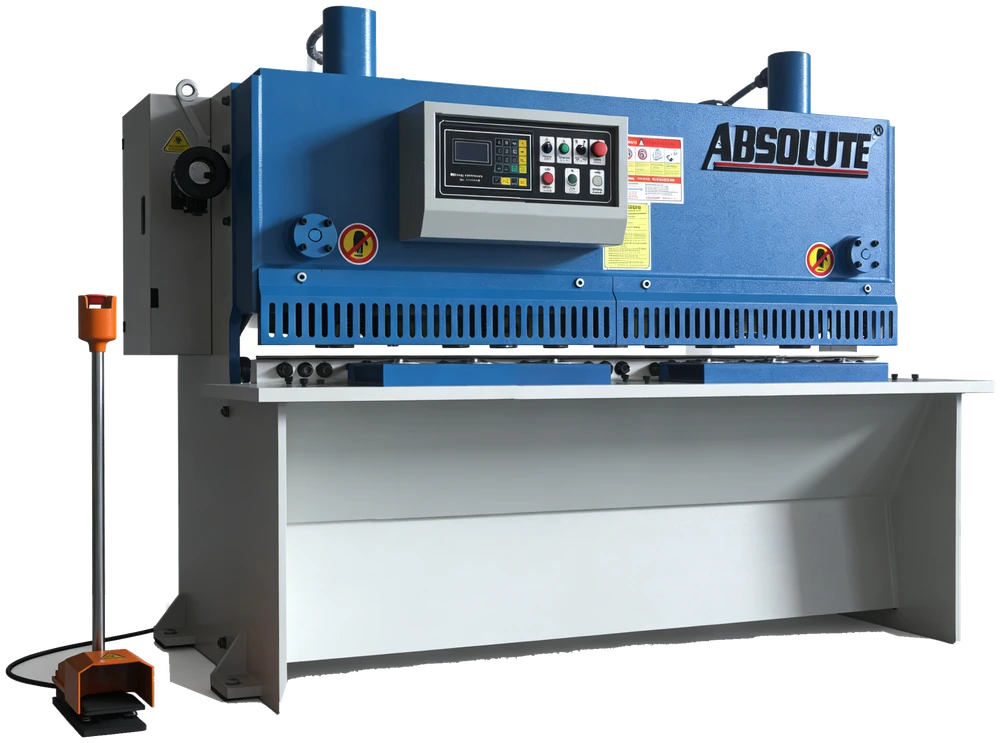
The headline capacity of a shearing machine tells only part of the buying story. A workshop also needs the finished blanks to meet its dimensional and edge requirements, and the loading process to suit the people handling the sheet. Two quotations with similar cutting length and thickness figures can describe different equipment. A better comparison begins with the material, the part drawing and a defined method for checking the cut.
List the material grades and thicknesses you actually process, including the most demanding combination. A thickness rating stated for mild steel should not be applied automatically to stainless steel or another material with different strength. Give the supplier the longest cut and the full sheet dimensions, so the proposed capacity can be checked against both the material and the working length.
Then describe the finished blank. Include strip width, required length, dimensional tolerance and acceptable edge condition. Identify any narrow strips that may be sensitive to deformation. If the drawing includes internal openings or complex contours, a straight sheet metal shear will not perform every operation. Discuss how shearing fits with punching, laser cutting, bending or another process in the complete workflow.
On a swing beam shear, the upper blade carrier pivots through an arc. On a guillotine shear, the upper blade carrier travels along guides. These descriptions explain the general movement, but they do not establish the quality of every machine using that structure. Guidance, adjustment provisions, blade arrangement and overall configuration still need to be reviewed for the model offered.
Ask how blade clearance is set and what rake angle adjustment is available. Some hydraulic guillotine configurations provide adjustable rake, but the details should be confirmed rather than assumed. Electric shearing machines should also be assessed from their actual drive and capacity information. Choose the structure through a review of your cutting requirement, rather than a blanket claim that one design is best for every job.
Blade clearance needs to suit the material and thickness. An unsuitable setting can affect burr formation and the condition of the edge. Rake angle influences cutting load and deformation, with narrow strips deserving particular attention. Ask the supplier how settings are selected and adjusted across the material range that you have specified.
State what happens after cutting. A blank going straight to a bending operation may have different edge requirements from a component that will be welded or assembled. Explain the amount of deburring your process allows, and whether flatness or visible edge condition is important. Agree on the acceptance criteria using representative material; a clean cut in a demonstration with a different sheet may not answer your production question.
A digital backgauge position is useful, but finished dimensions also depend on sheet alignment, support, material condition and the cutting setup. Ask about the available positioning range, adjustment method and how the operator checks a new job. Review the measuring method for the finished blank, not only the number shown on the control.
Thin or flexible sheets can require support during positioning and cutting. Large sheets can need a handling plan even when their thickness is within the nominal capacity. Discuss front support arms, rear support options and loading equipment as appropriate to the application. Clarify which items are included, and make sure the planned arrangement leaves practical access for the operators.
Prepare a small set of cuts covering typical work and a difficult case. Specify the material, thickness, finished dimensions and inspection method. When reviewing results, record the blade settings and support arrangement used. This creates a useful record for comparison and avoids treating a general demonstration as proof of every cutting condition.
If output is important, review a complete cycle: loading, alignment, cutting, handling the blank and removing scrap. Ask what staffing and equipment were assumed. A machine stroke rate is not the same as a finished production rate. The useful comparison is whether the proposed process can handle your expected batch sizes with the material flow available in the workshop.
Send the material list, thickness range, longest cut, sheet dimensions, blank drawings and daily production needs. Include destination country, voltage, phase, frequency and available space. Ask about the documentation and safeguarding supplied for the exact configuration, and review local installation requirements. Keep technical assumptions separate from optional equipment and commercial terms.
For an initial reference, use the shearing machine selection checklist from Absolute CNC. A useful inquiry asks for a proposed machine, blade settings, handling arrangement and inspection plan against the same requirements. That gives a buyer a practical basis for comparing quotations before deciding which configuration belongs in the workshop.
Have a part drawing to review? Send your machine requirements for a configuration and quotation.

Contact:Alice Li
Tel:+86 13115000086
E-mail:info@cnabsolute.com
Address:Mingjue Industry Zone,Lishui Town,Nanjing City,Jiangsu Province,CHINA.
Copyright © 1990-2026 Absolute Cnc Machine Co., Ltd. ABSOLUTE